
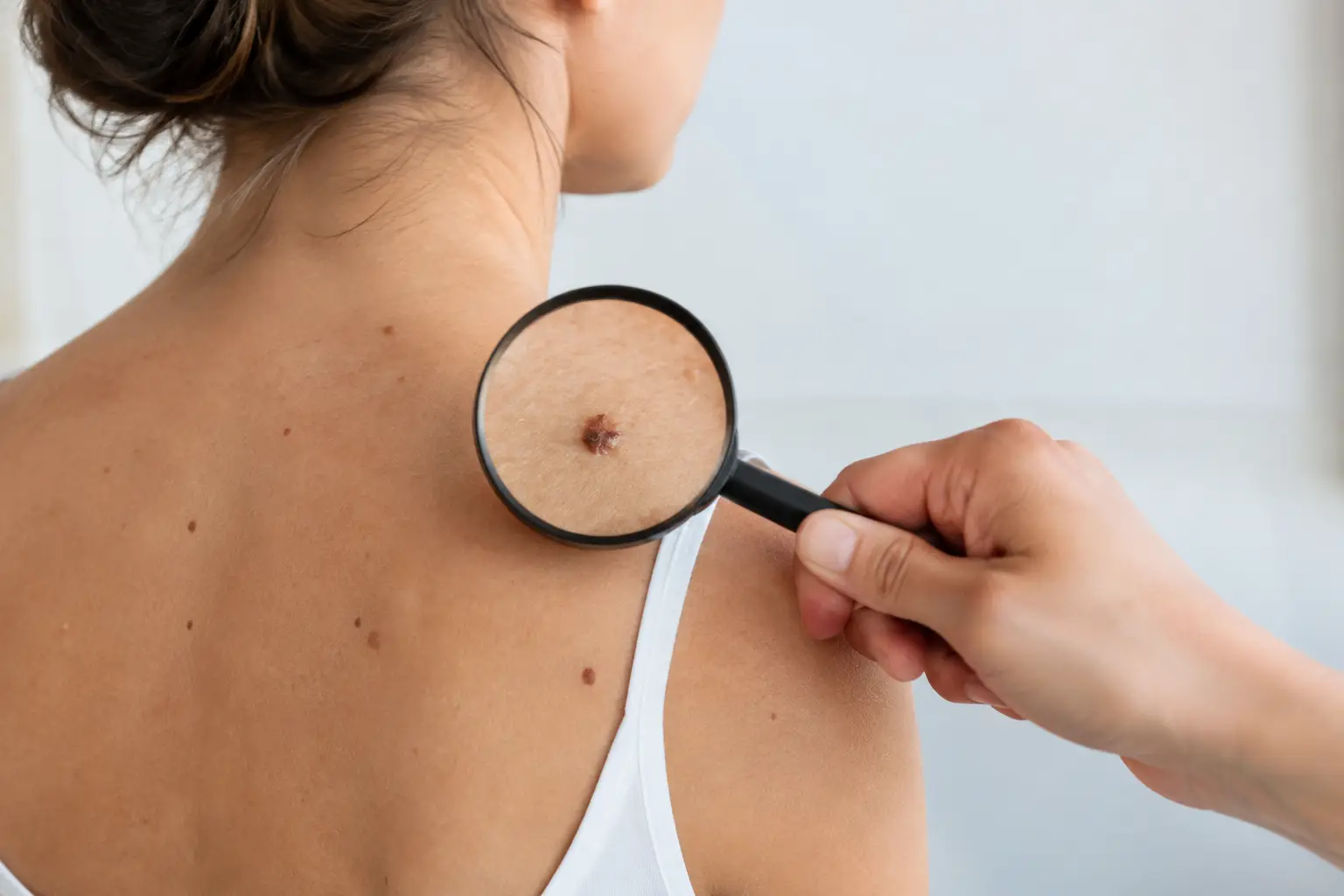
A mole that has always looked the same rarely commands attention. The spot that deserves a closer look is often the one that seems new, different, or unexpectedly active: darker than it was last season, irregular at the edge, itchy, bleeding, or simply unlike the rest of your skin. Knowing the suspicious mole warning signs can help you act promptly without assuming every change is skin cancer.
Most moles are benign, and many changes have harmless explanations. Still, melanoma and other forms of skin cancer are most treatable when found early. A thoughtful skin check at home, paired with professional examinations when appropriate, is one of the most practical ways to protect your skin health.
Suspicious Mole Warning Signs to Watch For
Dermatologists often use the ABCDE rule as a useful starting point. It is not a diagnosis, and not every concerning lesion follows every rule. Rather, it gives you a clear framework for noticing a spot that should be evaluated.
- A is for asymmetry. If you drew a line through the mole, would the two halves look noticeably different? Benign moles are often round or oval and relatively balanced. An uneven shape can be a reason to schedule an exam.
- B is for border. Look for edges that are scalloped, blurred, notched, or irregular rather than smooth and clearly defined.
- C is for color. More than one color within a single lesion can be concerning, especially shades of black, brown, tan, red, white, blue, or gray. A mole that becomes much darker or loses color deserves attention as well.
- D is for diameter. Spots larger than about 6 millimeters, roughly the width of a pencil eraser, warrant a closer look. But size is only one clue. Melanomas can be smaller, particularly when detected early.
- E is for evolving. A change in size, shape, color, elevation, texture, or symptoms is often the most meaningful sign. A mole that looks different from its own prior appearance should not be ignored.
The ABCDE approach is helpful because it turns a vague concern into something you can observe. Yet a spot does not need to check every box to merit an appointment. In practice, evolution and a lesion’s overall appearance often matter more than a single measurement.
The “Ugly Duckling” Sign Matters, Too
Many people naturally have a pattern to their moles. They may be mostly small and medium brown, or they may have many freckles that share a similar look. The “ugly duckling” concept asks a simpler question: does one spot look noticeably unlike the others?
A mole that is much darker, larger, pinker, more raised, or otherwise different from your usual pattern should be assessed, even if it is smaller than a pencil eraser or seems symmetrical. This is especially useful for people with numerous moles, for whom the ABCDE rule alone can feel difficult to apply.
Symptoms That Should Prompt a Dermatology Visit
Skin cancer does not always hurt, itch, or bleed. Waiting for discomfort can delay evaluation. That said, symptoms can be meaningful, particularly when they are new or persistent in a specific spot.
Make an appointment if a mole or pigmented area bleeds without a clear injury, develops a sore that does not heal, forms a crust repeatedly, feels tender, or becomes persistently itchy. Pay attention to a lesion that is growing, becoming raised after being flat, or changing rapidly over weeks to months.
Not every concerning lesion is a classic dark mole. Melanoma can be pink, red, skin-colored, or even nearly colorless. Basal cell carcinoma may appear as a pearly bump, a recurring scab, or a nonhealing sore. Squamous cell carcinoma can look like a rough, scaly patch or a firm, growing bump. Any changing or nonhealing area, regardless of color, is worth discussing with a dermatology professional.
When a New Mole Is Normal – and When It Is Not
New moles are common in childhood and adolescence and can continue to appear into early adulthood. Hormonal shifts, including pregnancy, may also make existing moles look somewhat darker or larger as the skin stretches. These changes are often benign, but they should still be brought to your dermatologist’s attention if a spot is distinctly changing or atypical.
A brand-new pigmented lesion appearing after age 30 is not automatically dangerous, but it deserves more scrutiny than a new mole in a teenager. The same is true for a changing spot in an adult with significant sun exposure, a personal history of skin cancer, a family history of melanoma, fair skin that burns easily, many moles, or a weakened immune system.
There is a trade-off in trying to self-monitor every mark: vigilance is useful, but worry alone cannot distinguish a harmless mole from a lesion requiring treatment. Board-certified dermatologists use trained visual assessment, dermoscopy, clinical history, and, when needed, biopsy to make that distinction with greater precision.
How to Check Your Skin at Home
A monthly self-exam helps you become familiar with your baseline. Choose a well-lit room, use a full-length mirror and hand mirror, and examine your skin methodically. Look at your face, scalp, neck, torso, arms, hands, legs, feet, and the spaces between your toes. Check areas that receive little sun as well, including the underarms, groin, buttocks, and the backs of the legs.
For the scalp, part your hair in sections or ask a partner to help. If you wear nail polish frequently, periodically examine the nails and the skin around them. A dark streak beneath a nail, especially one that is new, widening, or extending onto the surrounding skin, should be evaluated.
Photographs can be useful for tracking a lesion over time, provided they do not replace an examination. Take clear images in consistent lighting and include a familiar object for scale. If you notice change, do not wait months to see whether it settles down. Contact a dermatology office for guidance.
What to Expect During a Professional Skin Exam
A full-body skin examination is straightforward, private, and tailored to your history. Your dermatologist will ask about lesions you have noticed, past sun exposure, tanning bed use, family history, medications, and prior skin cancers. They will examine visible areas of skin and may use a dermatoscope, a handheld magnifying device with specialized lighting, to evaluate pigment patterns not visible to the naked eye.
If a lesion appears concerning, your dermatologist may recommend a biopsy. This involves numbing a small area and removing all or part of the lesion for examination under a microscope. A biopsy is the only way to definitively diagnose melanoma and many other skin cancers. It is not a sign that cancer is certain – it is the appropriate step when a spot needs an answer.
For patients with many atypical moles or a higher melanoma risk, the right screening schedule depends on individual factors. Some people benefit from annual skin exams, while others may need more frequent surveillance. Your dermatologist can build a plan that reflects your skin, history, and level of risk.
Sun Protection Is Prevention, Not Permission
Daily sun protection reduces cumulative ultraviolet exposure and supports healthy skin aging, but it does not eliminate the need to watch for changing lesions. Use a broad-spectrum sunscreen with SPF 30 or higher, apply it generously to exposed skin, and reapply when outdoors for extended periods, sweating, or swimming. Hats, sunglasses, shade, and protective clothing offer reliable additional coverage.
A tan is a sign of skin injury, not a measure of skin health. Indoor tanning devices also increase skin cancer risk and can accelerate visible sun damage. If you enjoy spending time outdoors, protection allows you to do so more thoughtfully – not fearfully.
At McLean & Potomac Dermatology and Skincare Center, skin checks are approached with the same individualized attention as every medical dermatology concern. Whether a spot turns out to be benign or needs treatment, timely evaluation provides clarity and a plan.
Your skin changes throughout life. Treat a mole that is new, evolving, symptomatic, or unlike its neighbors as a reason to be seen – and give yourself the reassurance that comes from expert care.